
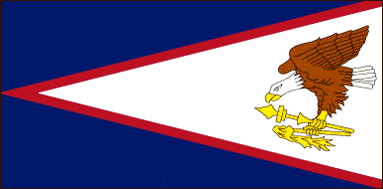
American Samoa
Country Guide
ASIA RELOCATION
American Samoa – Country Informations
- Dnh
- Infos reviewed 25/08/25
Have you decided to Move to American Samoa?
Whether you’re planning a tourist trip or a business relocation, here’s what you should know before you go.
American Samoa General Overview
- Official country name: Territory of American Samoa
- Location: South Pacific Ocean, Polynesia, approximately 2,600 miles southwest of Hawaii
- Capital city: Pago Pago (on Tutuila Island)
- Official language(s): English and Samoan
- Currency: United States Dollar (USD)
- Time zone: UTC-11 (Samoa Standard Time, no daylight saving time)
Culture & Traditions in American Samoa
- Key customs to be aware of:
- “Fa’a Samoa” (The Samoan Way) governs all aspects of life, emphasizing respect, service, and community.
- Matai system – traditional chiefs (matai) lead extended families (aiga) and have significant authority.
- Respect for elders and those of higher rank is paramount.
- Sunday is sacred – most activities cease for church and family time.
- Communal living and sharing are central values; individual needs are secondary to family/community.
- Traditional ceremonies and customs are taken very seriously.
- Number of official public holidays: 13 federal and territorial days
- New Year’s Day, Martin Luther King Jr. Day, Presidents’ Day, American Samoa Flag Day (April 17), Good Friday, Memorial Day, Independence Day (July 4), Labor Day, Columbus Day/Discoverers’ Day, Veterans Day, Thanksgiving Day, Day after Thanksgiving, Christmas Day, plus White Sunday (second Sunday in October – children’s day).
- New Year’s Day, Martin Luther King Jr. Day, Presidents’ Day, American Samoa Flag Day (April 17), Good Friday, Memorial Day, Independence Day (July 4), Labor Day, Columbus Day/Discoverers’ Day, Veterans Day, Thanksgiving Day, Day after Thanksgiving, Christmas Day, plus White Sunday (second Sunday in October – children’s day).
- Main traditional dishes and local drinks:
- Dishes:
Palusami (taro leaves with coconut cream), Oka (raw fish in coconut cream), Lu’au (taro leaves), Fa’ausi (coconut caramel dumplings), Panipopo (coconut buns), Sapasui (Samoan chop suey), Umu-cooked foods (earth oven), Koko Alaisa (cocoa rice), Fa’apapa (coconut bread). - Drinks:
Koko Samoa (Samoan cocoa), fresh coconut water, ‘Ava (kava – ceremonial drink), Vailima beer (imported from Samoa), tropical fruit juices, Vi (Tahitian chestnut drink).
- Dishes:
- Languages spoken daily and common expressions:
- Samoan and English are both widely used, often mixed in conversation.
- Samoan language is essential for full cultural integration.
- Common expressions:
- “Talofa” (Hello)
- “Fa’afetai” (Thank you)
- “Tofa” (Goodbye)
- “Mālō” (Well done/Congratulations)
- “Tulou” (Excuse me/Pardon me – used when passing in front of someone)
- “O a mai ‘oe?” (How are you?)
- Specific clothing and behavioral norms:
- Conservative dress is expected; modest clothing covering shoulders and knees.
- Lavalava (wrap-around sarong) is traditional daily wear for both men and women.
- Sunday best attire required for church – white clothing is traditional.
- Swimwear only appropriate at beaches, not in villages.
- Remove shoes before entering homes and churches (fale).
- Sitting cross-legged on the floor is common; avoid pointing feet at others or stretching legs.
- Walking through a village requires respectful behavior and appropriate dress.
- Cultural Festivals:
- Flag Day – April 17, American Samoa’s biggest celebration with week-long festivities, traditional dances, and competitions.
- White Sunday (Lotu Tamaiti) – Second Sunday in October, children are honored in church and family celebrations.
- Fire Knife Dancing Competitions – Various times throughout the year.
- Cricket Season – Traditional kilikiti (Samoan cricket) matches.
- Teuila Festival – September (when held), celebrating Samoan culture, crafts, and traditions.
Demographics & Society in American Samoa
- Total population: Approximately 49,000 (with significant emigration to Hawaii and mainland US)
- Major ethnic groups: Pacific Islander (92.6%) – primarily Samoan, Asian (3.6%), Mixed (2.7%), White (1.2%). Strong ethnic Samoan identity and culture.
- Main religion(s): Christianity dominates – Congregational Christian Church (50%), Roman Catholic (20%), various Protestant denominations (30%). Church is central to community life.
- General safety level:
- Very safe with extremely low violent crime rates.
- Strong community bonds and traditional authority maintain order.
- Petty theft can occur but is rare.
- Natural hazards include tsunamis, tropical cyclones, and earthquakes.
- Roads can be dangerous due to conditions and driving habits.
- Attitude towards foreigners and diversity:
- Samoans are generally friendly and welcoming to visitors who show respect.
- Foreigners (palagi) are expected to understand and respect Fa’a Samoa.
- Integration requires learning customs, language, and participating in community life.
- Small expat community primarily consists of US government employees, military personnel, and educators.
- Traditional culture is protective of land and customs; foreigners cannot easily purchase land.
- Family connections and relationships are essential for full acceptance.
- Age barriers can be challenging in smaller towns.
American Samoa Key Cities & Regions
- Capital city:
Pago Pago (3,700 in town, 50,000 metro area including surrounding villages) – Deep natural harbor, tuna fishing industry hub, government center, protected by dramatic mountains.
- Major villages and areas:
- Tafuna (8,200) – Largest village, location of airport, commercial center with shops and services.
- Nu’uuli (4,000) – Adjacent to Pago Pago, residential area.
- Fagatogo (1,700) – Government center, territorial offices, market.
- Leone (3,600) – Western district, historical significance, site of early missionary work.
- Vatia – Beautiful bay, traditional village setting.
- Aunu’u Island – Small island off eastern Tutuila, rural lifestyle, quicksand lake.
- Manu’a Islands (Ta’ū, Ofu, Olosega) – Remote eastern islands, traditional lifestyle, birthplace of Polynesian culture, limited services.
Weather & Climate in American Samoa
- Type of climate: Tropical rainforest, hot and humid year-round with heavy rainfall.
- Average seasonal temperatures:
- Dry season (May – October): 24-30°C, less rainfall but still humid, southeast trade winds.
- Wet season (November – April): 25-32°C, heavy rainfall, high humidity, cyclone season (December-March).
- Temperature variation is minimal throughout the year.
- Ocean temperature: 26-29°C year-round.
- Average seasonal temperatures:
Schooling in American Samoa
Public Schools:
– Free public education from elementary through high school
– American curriculum following US federal standards
– Medium of instruction: English (Samoan widely spoken informally)
– American Samoa Department of Education oversees all public schools
– Quality varies; some schools well-resourced, others struggle with aging facilities
– Strong emphasis on sports, particularly football (American Samoa produces many NFL players)
– Cultural education includes Fa’a Samoa (Samoan culture) and languagePrivate Schools:
– Very limited options
– *Samoa Adventist Academy* – Private Christian school in Leone
– Few other small private/church schools
– Generally small class sizes due to limited populationHigher Education:
– American Samoa Community College (ASCC) – Main higher education institution
– Associate degrees, vocational programs, teacher training
– Located in Mapusaga
– Affordable tuition for residents
– Some online programs available
– Many students travel to Hawaii, mainland US, or other Pacific islands for university educationKey Information:
– School year follows US calendar: August/September to May/June
– Sports programs highly competitive, especially football, rugby
– Traditional cultural education integrated into curriculum
– Limited AP or International Baccalaureate programs
– Children automatically receive US nationality if born in American Samoa to US national parentsChallenges:
– Limited advanced academic programs
– Aging school facilities and infrastructure
– Teacher retention issues
– Higher education requires leaving territory for most students
Health & Care in American Samoa
- System type: Universal healthcare (Sécurité Sociale)
- Different structures to get support:
Public hospitals, private clinics, general practitioners - Cost:
Basic care reimbursed, private insurance (“mutuelle”) recommended for full coverage
Banking in American Samoa
Major Banks:
– ANZ Amerika Samoa Bank (ANZ ASB) – Main commercial bank, Australian-owned
– Full-service banking: checking, savings, loans, mortgages
– Multiple ATMs throughout Tutuila
– Online banking available
– Territorial Bank of American Samoa (TBAS) – Government-owned development bank
– Focus on business development and home loans
– Limited consumer banking services
– Bank of Hawaii – Limited presence; mainly serves government and large businesses- Opening an Account:
– Requirements: Valid ID (passport or US state ID), Social Security Number, proof of address
– US Citizens/Nationals: Straightforward process, typically same-day
– Foreigners: More complex; may require work permit or visa documentation
– In-person application required; no online account opening
- Banking Features:
- Account types: Checking (often with fees), savings (low interest rates)
- Fees: Monthly maintenance fees common ($5-15); ATM fees for non-customers
- Limited hours: Generally Monday-Friday 9 AM – 3 PM; closed weekends
- ATMs: Available in Pago Pago and main villages; limited elsewhere
- Online banking: Basic services available through ANZ ASB
- Payment Methods:
- Cash: Still widely used – US Dollar is official currency
- Checks: Still common for bill payments
- Debit cards: Widely accepted in stores and restaurants
- Credit cards: Major cards (Visa, Mastercard) accepted at most businesses; limited merchants
- Mobile payments: Limited adoption; Apple Pay/Google Pay not widely available
- Key Limitations:
- No major US banks: Bank of America, Wells Fargo, Chase not present
- International transfers: Expensive and slow; limited options
- Investment services: Very limited; no brokerage services locally
- Credit building: Local credit history separate from US mainland
- Currency exchange: Very limited services; US Dollar only currency
- Practical Considerations:
- Maintain US mainland bank account if possible – useful for online transactions, broader services
- Wire transfers: Expensive ($25-50 per transaction); plan accordingly
- Check cashing: Some stores offer services but with fees
- Banking deserts:
- Remote villages have no bank access; cash economy prevails
- Internet banking reliability: Depends on internet connection quality
- Financial services limited: Wealth management, investment advice virtually non-existent locally
- For Expats:
- Open local account for salary deposits and daily expenses
- Keep mainland US account for online purchases, subscriptions, investments
- Bring sufficient cash when arriving – account setup may take time
- Credit cards from mainland banks work but inform bank of American Samoa usage
- Money transfers to/from mainland can take 3-5 business days
- Western Union and MoneyGram available for remittances
- Important Notes:
- American Samoa has separate banking system from US mainland despite political relationship
- FDIC insurance applies to ANZ ASB deposits
- Financial infrastructure basic compared to developed countries
- Plan finances carefully given limited banking options and services
American Samoa Practical Informations
- Entry requirements:
- US Citizens: No passport required (birth certificate and photo ID acceptable); can stay indefinitely.
- Non-US Citizens: Passport required; visa requirements vary by nationality.
- Tourist permits: 30-day entry permit typically granted on arrival; extensions possible.
- Work permits: Required for employment; usually arranged by employer.
- Residence: Establishing legal residence can be complex; consult territorial immigration.
- Note: American Samoa has separate immigration from the United States.
- Local transportation options:
- Aiga buses – Colorful local buses, inexpensive but irregular schedules, main transport for locals.
- Taxis – Available but limited; negotiate fare in advance or agree on rate.
- Rental cars – Available at airport and Pago Pago; recommended for flexibility; drive on right side.
- Inter-island flights – Polynesian Airlines connects Tutuila with Manu’a Islands (limited schedule).
- Ferries – Irregular service to nearby islands; check schedules locally.
- Walking – Common in villages but distances between areas can be significant.
- No public transport on Sundays – respect for Sabbath.
- Cost of living:
- Housing: Rent for a two-bedroom house/apartment: $800-1,500; limited rental market, often requires connections. Learn more here…
- Food: Groceries expensive due to importation; local produce affordable at markets. Restaurant meals: $10-20.
- Transport: Gas prices similar to US mainland; aiga bus rides: $1-2.
- Utilities: Expensive – electricity, water, internet costs are high.
- Overall: Higher than US mainland for many items due to remote location and shipping costs; local lifestyle can be more affordable.
- Electrical outlets and voltage used: Type A, B, F, I outlets; 120V / 60Hz (US standard).
- Emergency numbers to know:
- Emergency (Police, Fire, Ambulance): 911
- Police: 633-1111
- Fire Department: 633-2222
- LBJ Tropical Medical Center: 633-1222
- Coast Guard: 633-5111
- Tsunami Warning: Sirens and local alerts
American Samoa Visitor Tips
- Gestures to avoid or cultural taboos:
- Never stand while others are seated in a fale (house) or during meetings.
- Don’t eat while walking through villages.
- Avoid pointing feet at people; feet are considered unclean.
- Don’t touch anyone’s head – it’s considered sacred.
- Never refuse food offered during ceremonies or visits.
- Don’t walk in front of seated people without saying “tulou” (excuse me) and bending slightly.
- Avoid public displays of affection.
- Respect sa (curfew bell) – typically 6-7 PM for family prayer time; stay quiet and still if caught outside.
- Specific regulations:
- Sunday observance: Most businesses closed; swimming, sports, and loud activities prohibited. Respect this strictly.
- Alcohol sales restricted; no sales on Sundays; limited availability.
- Modest dress required in villages – shoulders and knees covered.
- Photography: Always ask permission before photographing people or ceremonies.
- Dogs: Many villages have dogs; be cautious.
- Fishing and marine resources: Follow local regulations; some areas restricted.
- Land ownership: Foreigners cannot own communal land (95% of territory).
- Tips for integrating locally:
- Learn Samoan language – essential for acceptance and understanding culture.
- Participate in church activities – church is center of community life.
- Understand and respect Fa’a Samoa – read about customs and ask questions respectfully.
- Build relationships with matai and community leaders.
- Contribute to communal activities and village projects.
- Observe Sunday strictly – no work, shopping, or recreational activities.
- Dress modestly and appropriately at all times.
- Be patient – island time is real; flexibility is necessary.
- Accept and participate in traditional ceremonies when invited.
- Understand the aiga system – extended family obligations are paramount.
- Potential risks or important considerations:
- Natural disasters: High risk of tsunamis (2009 tsunami caused significant damage), cyclones, earthquakes, flooding.
- Healthcare: Limited medical facilities; LBJ Tropical Medical Center provides basic care; serious conditions require evacuation to Hawaii.
- Isolation: Remote location; limited flights (mainly via Hawaii); shipping delays common.
- Infrastructure: Basic infrastructure; occasional power outages; limited internet speeds; unreliable water supply in some areas.
- Employment: Limited job market; most positions with government, tuna canneries, or schools; unemployment is high.
- Cost of living: High costs for imported goods; shipping expenses add significantly to prices.
- Culture shock: Traditional lifestyle very different from Western norms; adjustment can be challenging.
- Climate: Constant heat and humidity; mold issues; heavy rainfall.
- Limited services: Few entertainment options; limited shopping; basic amenities.
- Dogs: Free-roaming dogs can be aggressive; be cautious.
- Healthcare for chronic conditions: Limited specialist care available locally.
ASIA RELOCATION
Moving to American Samoa? Here’s Why It’s a Great Choice!
Moving to American Samoa? Here’s Why It’s a Great Choice!
American Samoa offers a unique opportunity to experience authentic Polynesian culture while remaining under US jurisdiction. This remote Pacific paradise is ideal for those seeking a slower pace of life, strong community bonds, and immersion in traditional island culture. While challenging in many respects, American Samoa rewards those who embrace Fa’a Samoa with a deeply meaningful and connected lifestyle.
A Unique Cultural Experience and US Territory Status
American Samoa provides an unparalleled opportunity to live in one of the last remaining traditional Polynesian societies while enjoying US territorial benefits. The territory maintains strong cultural traditions, with Fa’a Samoa governing daily life and matai chiefs leading communities. For Americans, no passport is required, and US currency is used, simplifying logistics. Employment opportunities exist primarily with the territorial government, tuna canneries (StarKist), National Park Service, and educational institutions. The territory offers a genuine cultural immersion experience unavailable in more developed Pacific locations, with strong community bonds and traditional ceremonies still central to life.
Natural Beauty and Island Lifestyle
American Samoa boasts breathtaking natural beauty with dramatic volcanic peaks, pristine rainforests, and crystal-clear waters. The National Park of American Samoa protects unique ecosystems and offers world-class hiking, snorkeling, and wildlife viewing. The islands remain relatively undeveloped and uncrowded, providing an authentic tropical paradise experience. The slower pace of life, emphasis on family and community, and connection to nature offer respite from modern stress. For those willing to adapt to traditional customs, limited amenities, and island isolation, American Samoa provides a profoundly different and enriching lifestyle.
Make Your Move Stress-Free with Asia-Relocation.com
Relocating to American Samoa requires careful planning and cultural preparation. Asia Relocation makes the process smooth and hassle-free. Our team specializes in international and domestic moving services, visa and immigration assistance, home searches, and settling-in support. We handle all logistics, including shipping to this remote location and helping you understand cultural expectations, so you can focus on embracing your new life in American Samoa.
Whether you’re moving for government work, teaching, conservation, or seeking a traditional island lifestyle, Asia Relocation ensures a seamless transition.
We understand that moving to a new country involves more than just packing boxes. Our team provides comprehensive relocation services, including:
✔️ International moving and shipping
✔️ Visa and immigration assistance
✔️ Housing and school search
✔️ Settling-in services (bank accounts, healthcare registration, etc.)
With our expertise, you can enjoy a smooth transition to American Samoa without the stress. Let us handle the logistics while you focus on starting your new adventure!
📞 Contact us today to start your journey to American Samoa with confidence.