
Thailand Retirement Visa: What to Know Before You Move
What the visa really is, who qualifies, and what to prepare — a plain-language guide to retiring long-term in Thailand, from the O-A deposit to the annual renewal.

Thailand consistently ranks among the most popular places to retire abroad — a mild climate, a reasonable cost of living, and medical care that is genuinely accessible in the larger cities. But before you settle in Chiang Mai or Bangkok, one question comes first: which visa lets you stay long-term? This guide sets out the essentials of the Thailand retirement visa in plain language — what it is, who qualifies, and what to prepare — so you can plan your move with confidence.
On this page
01What Thailand's "retirement visa" really is
Thai law has no visa officially called a "retirement visa." What people mean by the term is the Non-Immigrant O-A (long stay) visa, issued to foreign nationals aged 50 and over. A longer-stay variant, the Non-Immigrant O-X, offers a five-year initial period for applicants who meet higher financial conditions. The O-A is issued by Royal Thai embassies and consulates abroad, while annual extensions of stay are handled inside the country by the Immigration Bureau of Thailand. Both sit inside the same Non-Immigrant family as the work and study categories — the ones covered on our Non-Immigrant B, ED & O visas page.
⚠ What it is not
There is no single document stamped "retirement visa." The real decision is choosing between the O-A and the O-X — and meeting each one's financial test. For the current categories, official forms, and conditions, see our Thailand visa & immigration page.
02Who qualifies — the main conditions
The core requirements for the Non-Immigrant O-A are stable in outline, but the exact amounts and documents can change. As a guide, this is what the Immigration Bureau generally expects:
- Age — 50 years or older on the date of application.
- Proof of funds — a deposit of at least 800,000 THB in a Thai bank account, or a monthly pension of at least 65,000 THB, or a combination reaching that annual threshold. (⚠ figures current at publication — confirm before building your file.)
- Clean criminal record — a police clearance certificate from your country of residence.
- Health insurance — since 2019, cover of at least 40,000 THB for outpatient care and 400,000 THB for hospitalisation. (⚠ this requirement has changed several times — verify the current minimum.)
- Medical certificate — some consulates require one from an approved doctor.
03How long it lasts, and renewing each year
The Non-Immigrant O-A is granted for an initial period of one year. It is renewed annually through the Immigration Bureau in Thailand — at the Chaeng Watthana office in Bangkok, or at regional offices such as Chiang Mai or Phuket, depending on where you live. Each renewal means proving your finances and the validity of your insurance again. Our team supports clients through this annual process from start to finish.
The Non-Immigrant O-X takes a different approach: a five-year initial stay under stronger financial conditions — typically 3,000,000 THB held in a Thai bank. It suits applicants with more substantial savings who want to reduce yearly paperwork. (⚠ the O-X is open only to nationals of a limited list of countries — check eligibility first.)
04Beyond the visa: settling into life in Thailand
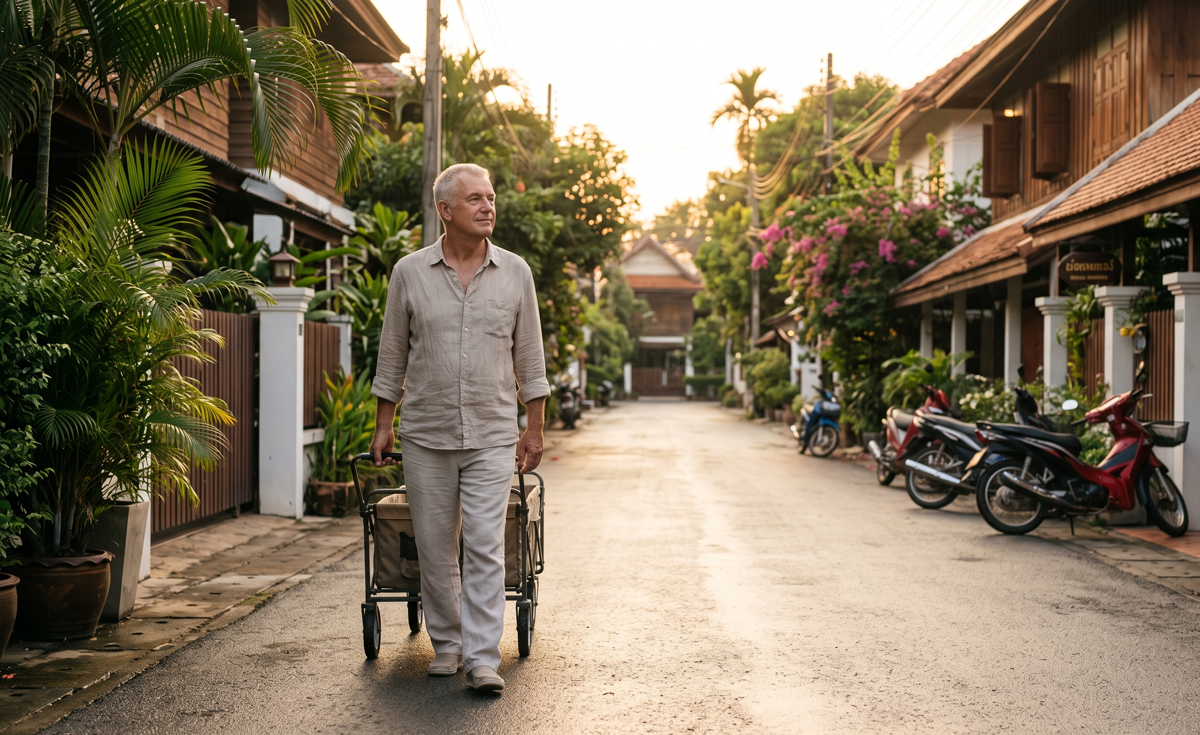
Securing the right visa is only the first step of a successful retirement in Thailand. Next comes finding the right home, opening a local bank account, learning how the healthcare system works, and settling into a new culture and rhythm. Where you base yourself shapes daily life more than anything else — and four options come up most often.
| Location | What it offers | Profile |
|---|---|---|
| Bangkok (Ari / Phrom Phong) | Top hospitals, international flights, serviced condos and every convenience — though rents run higher. | Capital comfort |
| Chiang Mai | Lower cost of living, a large established expat community, cooler air and a relaxed pace. | Value + calm |
| Pattaya | Coastal living within easy reach of Bangkok, with a long-standing foreign community. | Seaside |
| Phuket | Island lifestyle and strong private healthcare — at premium prices. | Island premium |
Our settling-in team handles the practical side — from the property search to finding your feet in a new daily life. And if the move itself weighs on you as much as the paperwork, our guide to relocating abroad as a retiree covers what changes once the visa is granted.
05Your pre-application checklist
Before you submit your file, run through these five points.
- You are 50 or older on the date of application.
- Your Thai bank account holds the required amount, or your monthly pension meets the threshold.
- Your health insurance covers the minimums required for the O-A.
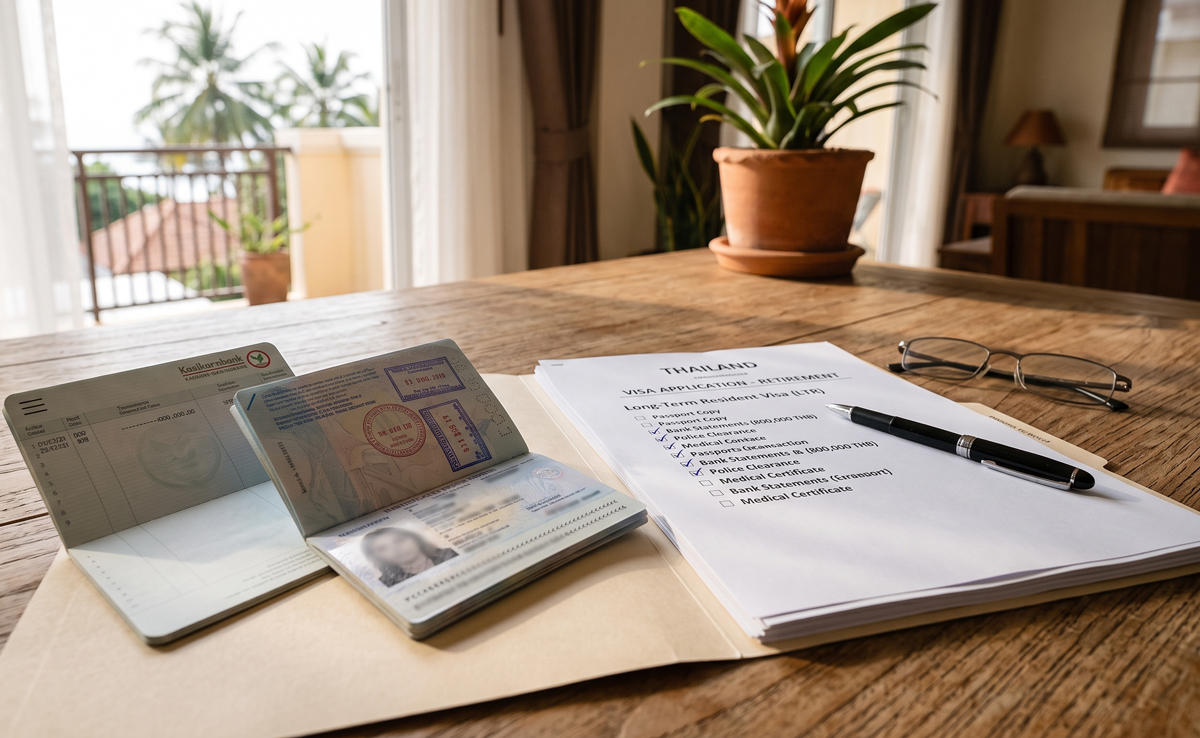
- Your police clearance (translated and apostilled where needed) is less than three months old.
- You have confirmed the exact conditions with the relevant Thai consulate or via the official Thai e-Visa portal, as requirements vary slightly by point of application.
Good to know
Small inconsistencies between your form, your bank evidence, and your insurance certificate are the most common cause of delay. Aim for one coherent, up-to-date set of records.
06Is the retirement visa right for your plans?
The Thailand retirement visa is an accessible route, provided you plan the financial evidence and the health cover ahead of time. With careful preparation, it offers a stable legal basis for settling in the country for the long term.
800k THB
Key figure
The reference bank deposit that underpins most Non-Immigrant O-A applications.
Ready to plan your retirement in Thailand?
Tell us about your situation and we will confirm the right route for your age, finances, and timing. Talk to our Thailand visa & immigration team →
07Thailand retirement visa — common questions
Can I work in Thailand on a Non-Immigrant O-A retirement visa?
No. The Non-Immigrant O-A grants no right to work. Any paid activity in Thailand — even, in some contexts, remote work for a foreign employer — requires a Work Permit issued by the Department of Employment. If you want to combine retirement with light professional activity, other statuses such as the DTV (Destination Thailand Visa) are worth reviewing with our team.
Do I have to open a Thai bank account?
For the Non-Immigrant O-A, the simplest way to prove your funds is a deposit in a Thai bank (Kasikorn Bank, Bangkok Bank, or SCB, for example). You can technically rely on a monthly pension transferred from abroad, but that is harder to evidence at renewal. In practice, a local account is strongly recommended.
What happens if I overstay my visa?
Overstaying in Thailand is penalised by the Immigration Bureau: a daily fine, a possible re-entry ban depending on how long you overstayed, and difficulty obtaining future Thai visas. Start your renewal several weeks before your permission to stay expires.