Living in Sukhumvit, Bangkok: Choosing the Right Soi for Your Move
One corridor holds most of central Bangkok's rental stock — but the difference between Soi 39 and Soi 77 is a different budget, a different commute and a different life. Here is how the sois actually compare, and what a lease really costs.
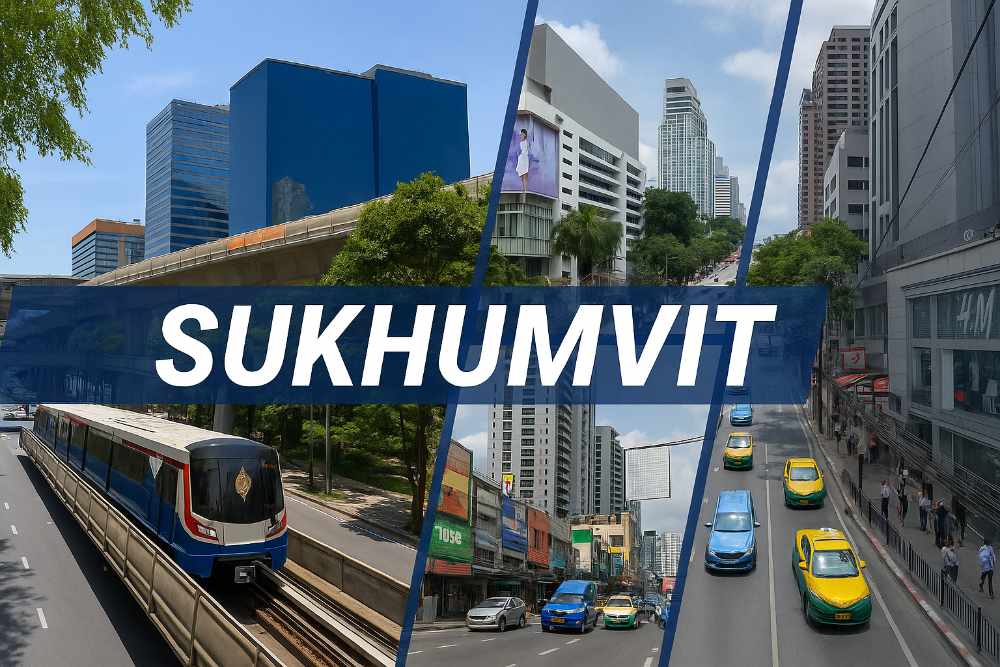
Nearly every household we settle in Bangkok looks at Sukhumvit first, and most of them stay. Living in Sukhumvit means living along a single 20-kilometre spine that runs east from the city centre, tracked almost end to end by the BTS Skytrain. That spine is not one neighbourhood: it is a dozen of them, and they do not cost the same, suit the same people, or feel remotely alike. A family that would be miserable on Soi 11 is perfectly happy on Soi 63. This guide breaks the corridor down soi by soi, sets out what each band actually rents for, and names the costs that never appear in the advertised price. If you would rather have the shortlist built for you, that is what our Thailand home search service does.
On this page
01Why the corridor still holds the market
The dominance is not an impression, it is a share. In the second quarter of 2025, CBRE Thailand counted 8,668 downtown rental apartment units in Bangkok — and Sukhumvit held 86% of them. Occupancy across that downtown stock reached 94.4%, up 1.3 percentage points on the previous quarter and three points year on year. Average asking rents stood at 584 baht per square metre, 4.1% higher than a year earlier.
86%
Key figure
Share of central Bangkok's rental apartment supply sitting in the Sukhumvit corridor (CBRE, Q2 2025). It is why your shortlist keeps landing here.
Priced per square metre, the corridor sits mid-table rather than at the top: Lumpini and Siam averaged 635 baht, Sukhumvit 594, and Silom with Sathorn 505. So Sukhumvit is not the cheapest address in Bangkok and it is not the dearest. What it has is depth — the sheer number of units means you can find a studio at 22,000 baht and a family townhouse at 200,000 within twenty minutes of each other.
Demand is corporate and international, and Japanese transferees are consistently named as its steadiest component. That matters practically: it keeps a whole layer of services alive here — bilingual building management, Japanese clinics and supermarkets, agents who have handled the same relocation a hundred times.
⚠ These figures are from Q2 2025
They are the most recent full quarterly set we can attribute, published by CBRE Thailand and reported in the Thai press. Treat them as the shape of the market rather than today's asking price, and expect current quotes to have moved. Ask us for the live figures before you set a budget.
02What the corridor gives you
Sukhumvit's appeal is not one feature, it is the fact that five different households can each find their reason. Here is what is genuinely on offer, stripped of the brochure language.
- Rail, end to end — the BTS runs from Nana out past On Nut, with MRT interchanges and an Airport Rail Link connection. In a city where a three-kilometre taxi ride can take forty minutes, this is the single feature that changes daily life most.
- Hospitals you will actually be referred to — Bumrungrad and Samitivej Sukhumvit both sit on the corridor. For retirees and families this often outranks the apartment itself.
- Everyday retail at walking distance — EmQuartier, EmSphere and Terminal 21, plus the wet markets and street food that make the area liveable rather than merely convenient. Benjakitti Park gives the western end real green space.
- Buildings run to international expectations — 24/7 security, on-site management, pools, gyms, covered parking and a maintenance desk that answers. This is what you are paying the premium for, more than the square metres.
- An expat layer that already exists — English-speaking services, international schools within reach, clubs and networks. It shortens the settling-in period measurably, particularly for an accompanying partner.
- Somewhere to work that is not your bedroom — dozens of coworking spaces and reliable fibre in most towers, which is why remote workers cluster in the eastern sois.
03What you will pay, by profile
Rent in Sukhumvit tracks who you are more than it tracks square metres, because each profile chases a different feature and competes with the same people for it. Four bands cover almost everyone we place.
| Profile | Typical unit | Monthly rent (THB) | Where they land |
|---|---|---|---|
| Corporate assignee | 2–3 bedrooms | 50,000 – 150,000+ | Phrom Phong · Thong Lo · Asoke |
| Family with school-age children | 3 bedrooms | 60,000 – 120,000+ | Near ISB or NIST |
| Retiree | 1–2 bedrooms | 25,000 – 60,000 | Quiet sub-sois, near hospitals |
| Remote worker | Studio or 1 bedroom | 20,000 – 40,000 | Ekkamai · Phra Khanong · On Nut |
Two of these bands are tighter than they look. Family three-bedrooms are scarce and their availability collapses in the run-up to the school year, so the range understates the difficulty. And the 20,000–40,000 band has become the most contested in the corridor since the Destination Thailand Visa brought a wave of long-stay remote workers into the eastern sois.
A correction worth making
The DTV is the Destination Thailand Visa. It turns up online as “Digital Television visa” often enough to be worth stating plainly — including in an earlier version of this very guide. It is a long-stay visa aimed at remote workers and soft-power activities, and it has visibly moved the mid-range rental market.
04Soi by soi
This is the part that decides your year. “Sukhumvit” on a lease tells you almost nothing — the soi number tells you everything. Working west to east:
| Area | What it is | Rent (THB) | The trade-off |
|---|---|---|---|
| Nana Soi 3–11 |
As central as the corridor gets, dense and every cuisine within walking distance | Variable | Nightlife-dominated and chaotic; property quality swings hard building to building. Not an area we recommend to families or retirees. |
| Asoke Soi 21–23 |
The BTS/MRT interchange, on the doorstep of the business district | Upper range | Busy, loud and dense. Superb for a short assignment, thin on neighbourhood feel. |
| Phrom Phong Soi 39 |
The upscale core — EmQuartier and EmSphere, the most polished stock on the corridor | 50,000 – 150,000+ | Among the highest rents in Bangkok, and it reads more shopping district than residential street. |
| Thong Lo / Ekkamai Soi 55 & 63 |
Dining, cafés and a strong resident community; several international schools nearby | 35,000 – 100,000+ | Expensive, and the sois themselves clog badly at peak hours. Noisy near the mouths. |
| Phra Khanong / On Nut Lower Sukhumvit |
The value end, still on the BTS, local markets and a fast-growing expat presence | 20,000 – 45,000 | Fewer luxury options, longer ride into the CBD, and infrastructure still filling in. |
The rule that saves most of the disappointment
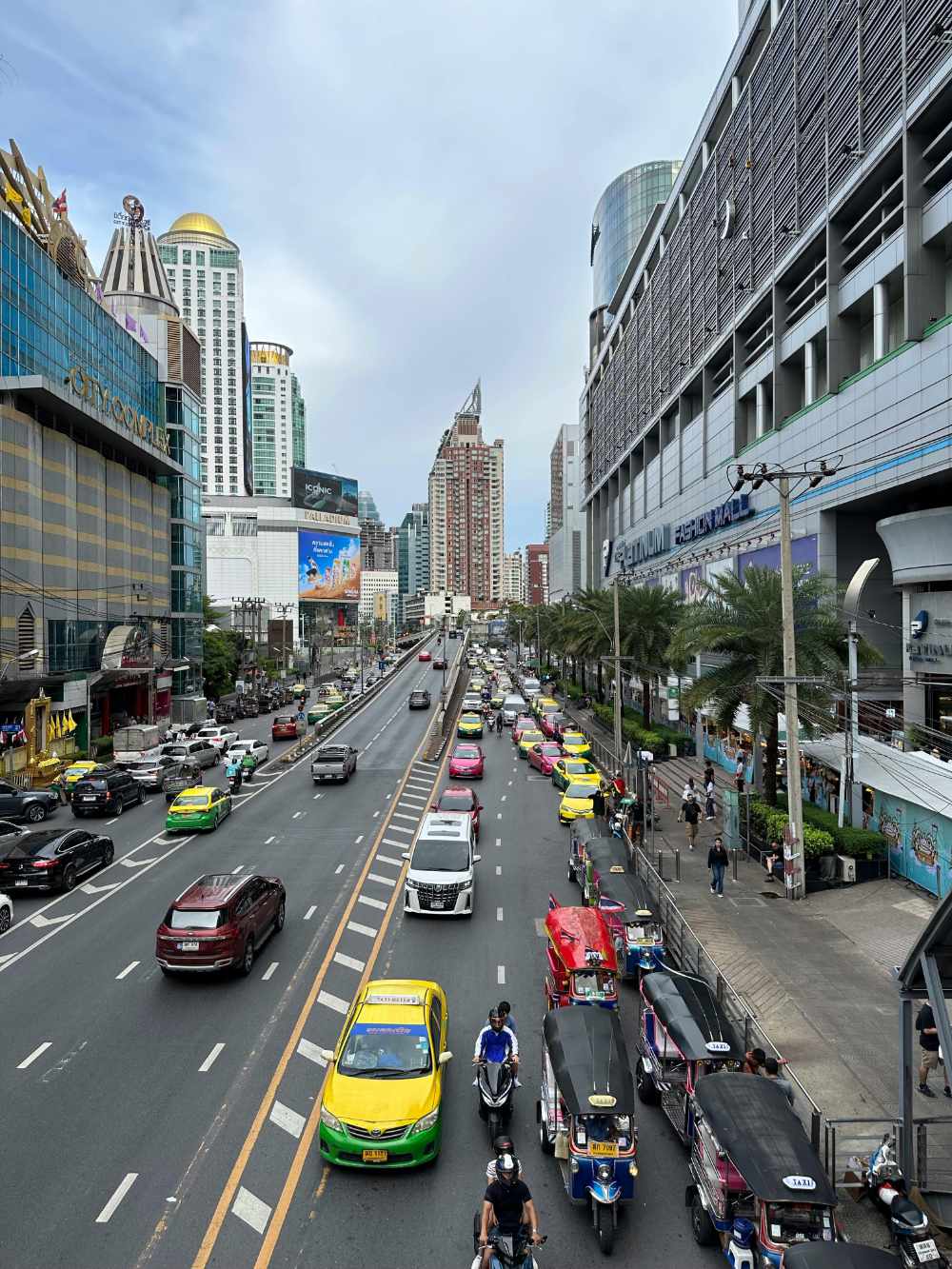
Stay within a five-to-ten minute walk of a BTS or MRT entrance. Beyond that, you are dependent on motorbike taxis in the heat and the rain, and the address stops delivering the one thing you moved here for. A cheaper unit fifteen minutes' walk from the station is rarely the bargain it appears to be.
05The costs that are not the rent
The advertised figure is the start of the budget, not the whole of it. What surprises people is not the size of these items but the fact that most of them fall due before you get the keys.
- Security deposit — usually two months' rent. Recoverable, but it leaves your account on signature.
- Advance rent — one to two months. Combined with the deposit, expect to move three to four months of rent at once.
- Common area fees — roughly 40 to 80 baht per square metre per month. On a 90 m² unit that is 3,600 to 7,200 baht, and whether the landlord absorbs it is negotiable.
- Electricity. Air conditioning in this climate is not a seasonal expense, and a poorly glazed high floor is expensive to keep cool.
- The serviced premium — 15% to 30%. Serviced apartments and full-facility condos cost that much more, and for a first posting or a short assignment they routinely earn it.
- Furniture and fit-out. “Furnished” covers everything from a complete home to a bed and a wardrobe. Inspect before you assume.
One habit is worth adopting from the start: get every one of these numbers in writing before you sign, not after. A lease negotiated in English and signed in Thai is only as clear as the version you actually understood.
06Timing your search
With occupancy above 94%, the good units are not waiting for you. They are committed four to eight weeks before the incoming tenant moves in, which sets the whole calendar backwards from your arrival date.
01
Two to three months out
Fix the non-negotiables: budget ceiling, bedrooms, the station you want to be near, and the school if there is one. This is also when you decide whether serviced is worth the premium.
02
Six to eight weeks out
Start viewing in earnest. Shortlist two or three sois rather than one — committing to a single soi is what forces people into a compromise unit.
03
Four weeks out
Decide quickly when the right unit appears. In this market, sleeping on it for a week usually means losing it. Have the deposit ready to move.
04
Signature and handover
Inventory the unit in photographs, confirm in writing who pays the common area fee, and check what the building requires for registration before you move furniture in.
⚠ Two windows to avoid if you can
May to August, when families arrive for the school year, and the turn of the year. Availability tightens and negotiating room disappears in both. If your start date is fixed inside those windows, begin two months earlier than you otherwise would.
07Common questions
What our Bangkok consultants are asked most often about the corridor.
How much does it cost to rent in Sukhumvit?
Studios and one-bedrooms run roughly 20,000 to 40,000 baht a month, one to two bedrooms 25,000 to 60,000, and family three-bedrooms 60,000 to 120,000 or more. Premium two and three-bedroom units near Phrom Phong, Thong Lo and Asoke reach 150,000 and beyond. Across the corridor, average asking rents were 594 baht per square metre in Q2 2025.
Which part of Sukhumvit is best for families?
Thong Lo and Ekkamai, on Soi 55 and 63, because several international schools sit within reach and the resident community is well established. Expect 35,000 to 100,000 baht and more, and expect traffic at peak hours. Families whose school is elsewhere should let the school decide the soi, not the reverse.
How far ahead should I start looking?
Two to three months before your arrival. Good units are committed four to eight weeks before the tenant moves in, so a search that starts on landing is already a month late. Add a further two months if you are arriving between May and August, when families relocating for the school year absorb the family-sized stock.
What should I budget beyond the monthly rent?
A security deposit of about two months, one to two months of advance rent, and common area fees of roughly 40 to 80 baht per square metre per month. That means three to four months of rent leaving your account at signature. Electricity is significant year-round because of air conditioning, and serviced apartments carry a 15% to 30% premium.
Is Sukhumvit a good choice for retirees?
For many, yes — chiefly because Bumrungrad and Samitivej Sukhumvit are on the corridor, and because the Skytrain removes any need to drive. Look at the quieter sub-sois and at buildings with reliable lifts, in the 25,000 to 60,000 baht band for one to two bedrooms. Avoid the Nana stretch, which is nightlife-dominated.
Is Sukhumvit more expensive than Sathorn or Silom?
Per square metre, yes, but not by much: in Q2 2025 Sukhumvit averaged 594 baht against 505 for Silom and Sathorn, while Lumpini and Siam topped the table at 635. Sukhumvit's real advantage is not price but depth of choice — it holds around 86% of central Bangkok's rental apartment supply, so the range of what you can find is far wider.
08When another area wins
We talk households out of Sukhumvit regularly, and the reasons are consistent. Traffic, air quality, noise and crowding are real costs in the prime stretches, and no amount of convenience cancels them if what you need is quiet.
If you want space and calm above all, the suburban developments — Nichada Thani, Bang Na, Ratchapruek — give you a garden and a considerably better rate per square metre, at the price of a long commute and a car-dependent life. If the budget is the binding constraint and you have no daily commute, the Rama 9, Lat Phrao and Ratchada corridors go substantially further. And if you simply want somewhere with more character than towers, the riverside districts or the low-rise streets of Ari are a different Bangkok altogether.
The honest test is not which area is best but which compromise you can live with for the length of your posting. Our Thailand relocation team works through that with arriving households every week, and we will tell you when the corridor is the wrong answer for you.
Ready to narrow it down?
Tell us your budget, your start date and where you need to be each morning, and we will come back with the sois that fit and the ones to rule out. Talk to our Bangkok housing consultants →