
Vietnam 2026 Outlook
GDP Trends, FDI Records, and 2026 Strategic Forecasts
Vietnam’s Economic Renaissance: A Comprehensive Analysis of the 2025 Growth Surge and the 2026 Strategic Horizon
In 2025, Vietnam emerged as a global frontrunner in economic resilience, achieving a remarkable GDP growth rate of 8.02%. This performance, one of the nation’s strongest in over a decade, propelled the total economy to approximately $514 billion and lifted GDP per capita to $5,026, firmly establishing Vietnam as an upper-middle-income country. Driven by a robust manufacturing sector, a resurgence in international tourism, and record-breaking foreign direct investment (FDI), the country exceeded initial international forecasts. As Vietnam enters 2026, the government has signaled a “new era” of ambition, setting a target for double-digit growth (approx. 10%) aimed at institutional reform and high-tech industrialization.
1. The 2025 Macroeconomic Landscape: Defying Global Headwinds
Vietnam’s economic story in 2025 is defined by its ability to maintain stability and accelerate growth despite a volatile global environment characterized by geopolitical conflicts and supply chain disruptions.
1.1 Key Performance Indicators
GDP Growth: The 8.02% annual growth was bolstered by an exceptional fourth quarter (Q4) which saw a 8.46% year-on-year increase.
Inflation Control: Despite rapid expansion, the average inflation rate was strictly controlled at 3.31%, providing a stable foundation for domestic consumption.
Monetary Stability: Throughout 2025, Vietnam maintained relative stability in exchange and interest rates, which enhanced investor confidence and provided the government with “ample room” to adjust policies further.
1.2 Sectoral Contributions to Growth
The growth in 2025 was broad-based, with significant momentum across all three primary pillars of the economy:
Industry and Construction: This sector led the charge with an 8.95% expansion. Manufacturing specifically grew by 9.97%, the highest rate since 2019, driven by high-tech electronics and textiles.
Services: Expanding by 8.62%, this sector benefited from a sharp recovery in trade and tourism. International arrivals reached an all-time high of nearly 21.2 million visitors.
Agriculture, Forestry, and Fishery: This sector maintained steady growth at 3.78%, ensuring food security and supporting rural incomes despite being impacted by natural disasters earlier in the year.
2. Strategic Drivers: The Engines of the 2025 Success
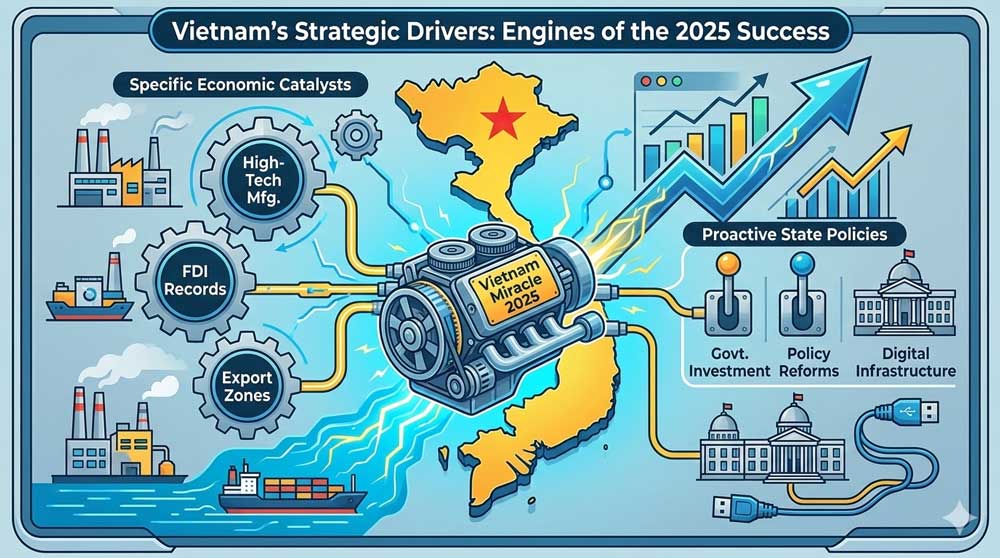
The “Vietnam Miracle” of 2025 was not accidental but the result of specific economic catalysts and proactive state policies.
2.1 The Export Powerhouse and Trade Resilience
Vietnam’s exports remained a vital pillar of the economy. High-tech products, particularly electronics, surged as Vietnam solidified its position in global value chains. Despite rising global trade tensions and the introduction of new tariffs, Vietnam’s export-oriented manufacturing demonstrated remarkable agility in diversifying markets.
2.2 Foreign Direct Investment (FDI) at Record Highs
Vietnam continued to be a magnet for international capital. FDI disbursements reached record levels in 2025, estimated between $27 billion and $38 billion. This influx of capital was increasingly directed toward high-value-added industries, reflecting a shift from low-cost assembly to more sophisticated manufacturing and technology-driven sectors.
The acceleration of foreign direct investment is also driving a parallel rise in international workforce mobility. As global companies establish new production facilities, R&D centers, and regional offices in Vietnam, expatriate assignments have increased noticeably in 2025 compared with 2024. This growth is particularly visible in sectors such as high-tech electronics, advanced manufacturing, and renewable energy, where foreign technical expertise remains essential during project development and early operational phases.
Looking ahead to 2026, the pipeline of announced investments suggests continued growth in expatriate deployments. For multinational corporations, Vietnam increasingly serves not only as a production base but also as a strategic hub for Southeast Asia operations. As a result, international mobility, including executive transfers, technical assignments, and project-based relocations, is expected to expand alongside the country’s industrial and technological transformation.
2.3 Domestic Consumption and Infrastructure
The domestic market of 100 million people also played a crucial role. Domestic consumption rose by 9-10%, supported by low inflation and rising per capita income. Concurrently, the state accelerated public and private infrastructure projects, which provided the necessary physical foundation for industrial expansion.
3. 2026: Transitioning to the “New Era” of Double-Digit Growth
Building on the momentum of 2025, the Vietnamese government has set forth a highly ambitious agenda for 2026 and the 2026-2030 period.
3.1 The 10% Growth Ambition
Authorities have announced a target of approximately 10% GDP growth for 2026. While international bodies like the World Bank and OECD initially projected more conservative figures (between 5.8% and 6.8%), the 2025 performance has led many analysts to revise their outlooks upward.
3.2 Strategic Priorities for 2026
To sustain and accelerate this pace, Vietnam is focusing on three critical “breakthroughs”:
Institutional Reform: Simplifying administrative procedures and creating a more “pro-business” regulatory environment to unleash market vitality.
High-Tech and Green Transition: Prioritizing investments in semiconductors, digital transformation, and renewable energy to move up the value chain.
Human Capital Development: Investing in high-tech talent and education to meet the demands of the “new economy”.
4. Challenges and Risks: Navigating the Path Ahead
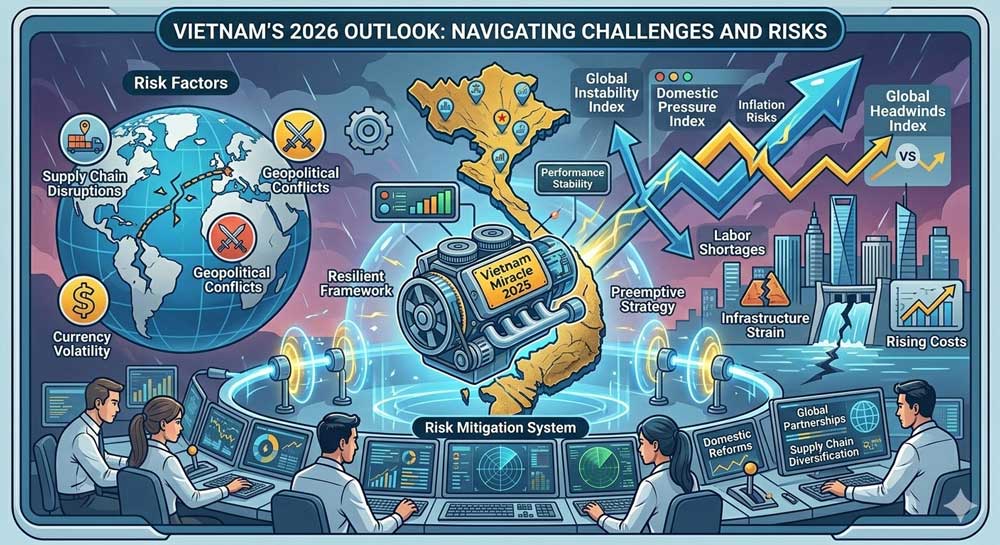
While the outlook is overwhelmingly positive, both domestic and international pressures call for caution.
4.1 Global Volatility and Trade Risks
As a highly open economy, Vietnam remains vulnerable to:
External Demand Fluctuations: Slowdowns in major trading partner economies could impact export volumes.
Trade Barriers: Increasing protectionism and shifting tariff regimes require constant diplomatic and economic adaptation.
Geopolitical Instability: Continued global conflicts may lead to energy price spikes or supply chain bottlenecks.
4.2 Domestic Bottlenecks
To achieve its 10% target, Vietnam must address several internal factors:
Infrastructure Gaps: Ensuring the energy grid and transport networks can handle increased industrial load.
Productivity Growth: Moving beyond labor-intensive growth to productivity-led expansion is essential to avoid the middle-income trap.
Environment and Climate Change: Balancing rapid industrial growth with environmental sustainability and climate resilience.
5. Conclusion: A Pivot Point in Asian Economic History
The year 2025 has been a defining moment for Vietnam. By reaching a GDP of over half a trillion dollars and maintaining 8% growth amidst global uncertainty, the nation has proven its resilience and strategic foresight.
The “10% target” for 2026 is more than a number; it represents a fundamental shift in national strategy toward high-quality, innovation-driven development. For investors and international partners, Vietnam today offers a unique combination of stability, ambition, and a proven track record of exceeding expectations. As the country steps into 2026, it is no longer just a “promising” economy but a central pillar of the global industrial landscape.
As foreign direct investment continues to expand and new industrial and technology projects come online, Vietnam is also expected to see a continued rise in expatriate assignments and international talent mobility in 2026, reinforcing the country’s position as a key destination for global professionals and corporate relocations in Southeast Asia.
| Indicator | 2025 Actual (Est.) | 2026 Target/Forecast |
| GDP Growth | 8.02% | ~10.0% |
| Total GDP | $514 Billion | Increasing |
| GDP Per Capita | $5,026 | Increasing |
| Inflation (CPI) | 3.31% | Stable |
| FDI (Disbursed) | $27 – $38 Billion | High |
| Tourism (Visitors) | 21.2 Million | Growth Target |
This report is based on documentation from the National Statistics Office of Vietnam, international economic updates (World Bank, OECD, UOB), and recent governmental policy announcements as of early 2026.
Looking to capitalize on Vietnam’s booming economy? Asia Relocation Vietnam provides expert guidance and seamless transition services to help you or your business thrive in this high-growth market.
Vietnam Economic 2026 Outlook
Frequently Asked Questions
What were the primary drivers of Vietnam's exceptional 8.02% growth in 2025?
The growth was fueled by three major pillars:
Industry and Construction (+8.95%): This sector saw a record performance in high-tech manufacturing, particularly in electronics and textiles.
Services Sector (+8.62%): Driven by a historic recovery in international tourism, reaching an all-time high of 21.2 million visitors.
Foreign Direct Investment (FDI): The country remained highly attractive to global capital, with record FDI disbursements estimated between $27 billion and $38 billion.
Is Vietnam now officially considered a high-income country?
In 2025, Vietnam reached a significant milestone. With a GDP per capita of $5,026, the country has firmly entered the upper-middle-income category. While this is a major achievement, the government’s long-term vision is to continue this trajectory to become a fully high-income economy by 2045.
Is the 10% GDP growth target for 2026 realistic?
This target is highly ambitious and signals the start of a “new era” for the nation. To reach it, the government is focusing on major institutional reforms, accelerating the transition to semiconductors, and investing in green technologies. While international bodies like the World Bank initially provided more conservative forecasts, the momentum from 2025 provides the state with significant monetary and policy “room” to push for this double-digit growth.

Other Blogs by Asia Relocation Vietnam