Section 13 Quota Visa in the Philippines: Essential Steps for 2026
What changed after the 2025 suspension, who qualifies now, which documents the Bureau of Immigration expects — and why, with only 50 slots per nationality each year, your filing date matters almost as much as your file.

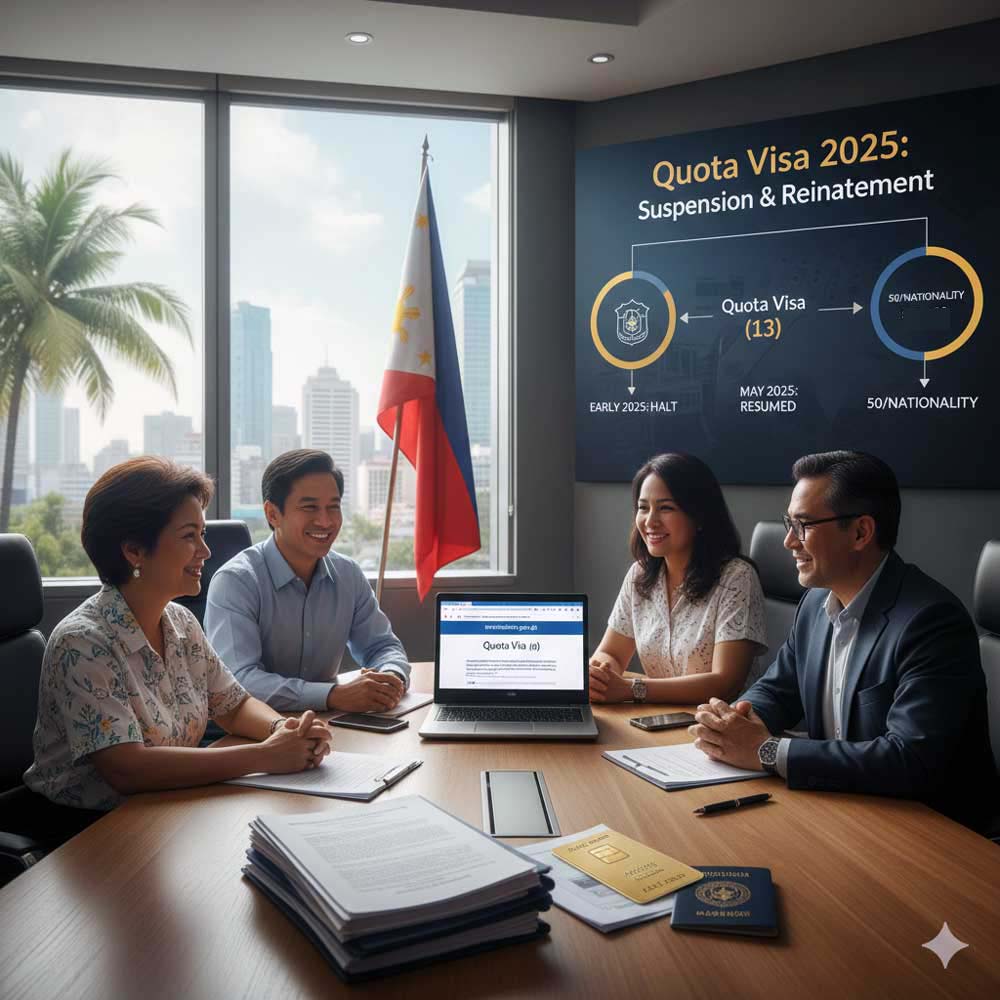
Very few foreigners become permanent residents of the Philippines without marrying a Filipino citizen or retiring here. The Section 13 Quota Visa is one of the rare exceptions: a numerically limited immigrant visa, open to nationals of countries that extend the same courtesy to Filipinos. In early 2025 the Bureau of Immigration (BI) suspended processing to review its standards, and the pause set off a wave of speculation about tougher financial thresholds. Processing resumed in May 2025 under revised administrative guidelines, and the route is active again. This guide sets out where things stand for 2026 — eligibility, documents, the procedure, the fees, and the timing that decides who gets a slot.
On this page
01What the Section 13 Quota Visa grants
The Quota Visa is an immigrant visa. The Bureau of Immigration defines an immigrant as a foreign national who comes to reside permanently in the Philippines — so an approved applicant receives permanent resident status, has their passport stamped, and is issued an ACR I-Card. It is not tied to an employer, a spouse, or a retirement programme, which is precisely why demand outstrips supply.
Two conditions are written into the statute and have never moved. The visa is open to nationals of countries which have diplomatic relations with the Philippines and grant Filipinos the same immigration privileges under the principle of reciprocity, and the number issued may not exceed fifty (50) of any one nationality for each calendar year. Stateless persons are entitled to the same annual quota of fifty, and the reciprocity test is waived in their case.
The law is from 1940, not 2025
A common confusion: nothing about this visa was legislated in 2025. The Quota Visa sits in Section 13 of Commonwealth Act No. 613, the Philippine Immigration Act of 1940, as amended. What changed in 2025 was administrative — how the BI screens applications — not the statute. A bill to replace the 1940 Act has been filed in Congress but has not been enacted.
⚠ What it is not
This is not a quick route, and it is not the only one. If you are married to a Filipino citizen or hold a local job offer, the 13A visa by marriage and the 9G pre-arranged employment visa are usually faster and are not capped — and both, like the Quota Visa, take their name straight from the 1940 statute, as we explain in why Philippine visas are called 9G and 13A. Quota numbers expire with the calendar year and cannot be carried over: miss the fifty, and you wait for January.
02The suspension and the May 2025 resumption
Early in 2025 the Bureau of Immigration halted Quota Visa processing to run a full review of eligibility standards and internal protocols. The stated concern was quality of applications: the law asks for qualifications or investment that benefit the country, and the BI wanted to be satisfied that applicants genuinely met that bar rather than treating the fifty slots as a queue.
Processing resumed in May 2025 under updated administrative guidelines. The statutory core was untouched — the 50-per-nationality cap and the reciprocity condition remain exactly as before — but new thresholds for age and financial capacity came in with the restart. By late 2025 the BI's operations and its official pages signalled a full return to normal service, and applications have been moving since.
⚠ The $150,000 rumour
During the pause, immigration forums and social media reported that the financial requirement would triple to $150,000. The BI never confirmed that figure and it was never implemented. The amount applicants are asked to evidence today is an inward remittance of $100,000. Treat any number you did not read on an official BI document as unverified.
03Philippines Section 13 Quota Visa eligibility & requirements
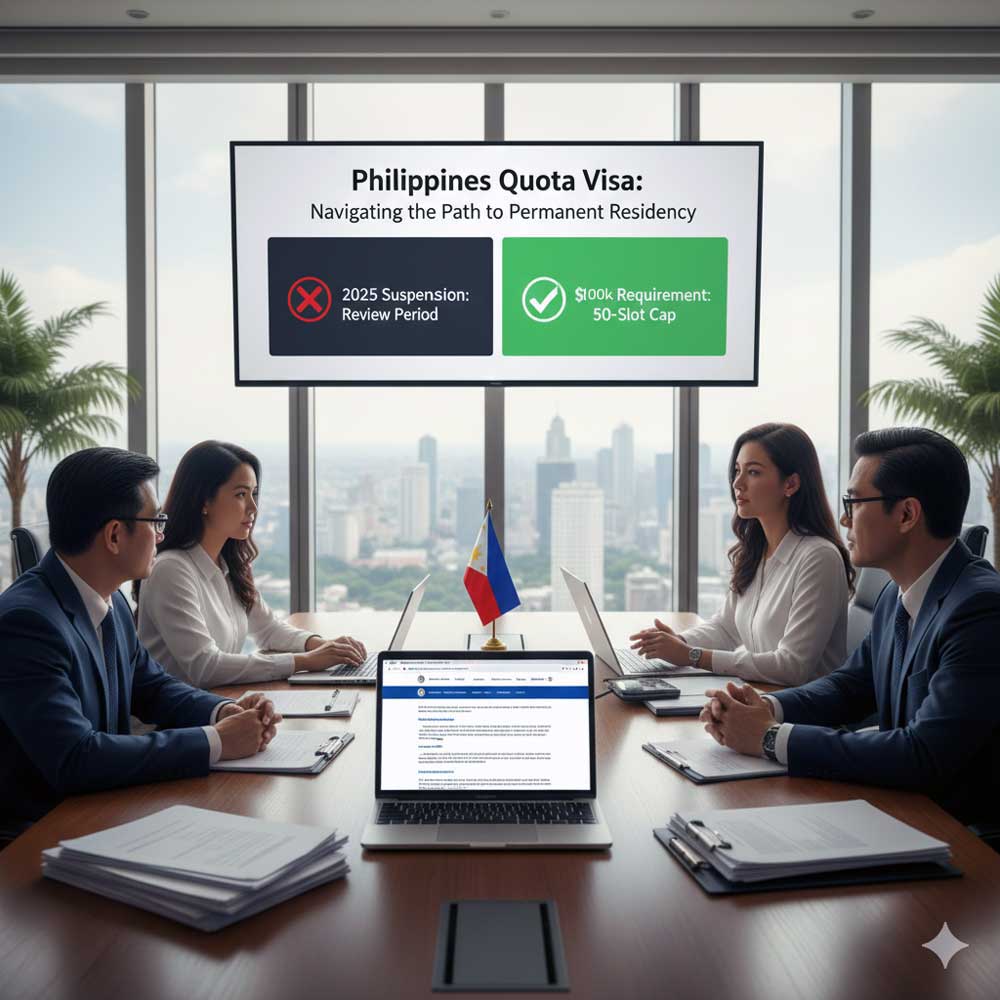
Applicants must be at least 30 years old, have a minimum prior stay of 180 days in the Philippines, transfer an inward remittance of $100,000, and follow the VIMS process to obtain permanent resident status under the 50-slot cap. Five conditions decide whether a file is worth preparing at all — two statutory, three from the guidelines applied since May 2025. Check all five before you spend a peso on notarisation and clearances.
- Age — applicants must be at least 30 years old.
- Proof of stay — a recorded stay of at least 180 days in the Philippines before applying, which in practice means arriving on another visa first.
- Reciprocity — your country must have diplomatic relations with the Philippines and grant Filipinos equivalent immigration privileges, assessed on Department of Foreign Affairs circulars and issuances. This one is statutory and cannot be waived, except for stateless applicants.
- Preferred class — you must fall into one of the two preferred categories: qualifications, skills or scientific, educational and technical knowledge that advance the national interest, or sufficient capital for a viable and sustainable investment. A comfortable retirement plan is neither.
- Financial capacity — a bank certificate evidencing an inward remittance of at least $100,000 into the Philippines.
Good to know
The BI's published Quota Visa page states only the statutory conditions — the 50-slot cap and reciprocity. The age bar, the 180-day stay and the $100,000 remittance come from the administrative guidelines applied since processing resumed, and administrative rules can be revised without a public announcement. Confirm the wording in force on the day you file.
04Which documents to prepare
A Quota Visa file has to tell one consistent story: who you are, why the Philippines benefits from your presence, and where the money came from. Three groups of documents carry it — identity and record, qualification and finances, then clearances.
- Consolidated General Application Form (CGAF) — two original copies.
- Valid passport — bio-page and the latest admission stamp showing a valid, current stay. You must hold a valid passport and a valid visa at the time you file.
- Criminal record clearance — an NBI clearance if you have been in the Philippines for six months or more; a police clearance from your home country if less than six months.
- Photographs — 2x2 inch colour photos on a white background.
- Letter of intent / petition — notarised, setting out your qualifications and the benefit you bring to the country. This is the document that carries the file.
- Financial and reciprocity proof — the bank certificate evidencing the $100,000 inward remittance, plus a document showing your country grants residency to Filipinos.
- Clearances and receipts — medical clearance from an accredited clinic or the Bureau of Quarantine, a BI clearance certificate confirming no derogatory record, and the official receipts for every filing fee.
Good to know
Names, dates and passport numbers must match across the CGAF, the bank certificate and the notarised petition. A middle name present on one document and absent on another is enough to send a file back for correction — and in a race for fifty slots, a correction cycle is expensive.
05How the VIMS application works
Quota immigrant visa applications are processed under the Bureau's Visa Issuance Made Simple (VIMS) programme, and a dedicated Screening Committee under the Office of the Commissioner handles them. Fees are assessed and paid in full before a file is accepted, applications are raffled to hearing officers, and the Commissioner takes the final decision. Expect to appear at the BI Main Office at least twice.
01
Pre-screening & payment
Submit the CGAF and supporting documents to the Central Receiving Unit for initial review, obtain the Order of Payment Slip, pay the fees and file the official receipt. Payment in full precedes acceptance.
02
Hearing
The file is raffled to a hearing officer, who has 15 days to resolve it and forward a recommendation to the Screening Committee. Your petition and your evidence of contribution are examined here.
03
Ranking & decision
The Committee lists qualified applicants by nationality in order of preference and sends the list to the Commissioner, who grants the visas by signed Order. Approved lists are posted at the BI Main Office and on its website.
04
Implementation & ACR I-Card
Submit your passport for visa implementation, then file for the ACR I-Card, which is released within 24 hours of filing. Only at this point are you a permanent resident.
⚠ Plan around this
The 15-day rule applies to one step, not to the whole file: in practice, allow around three months from filing to card in hand. The BI publishes no end-to-end processing time, and its fee schedule carries the note that amounts "may change without prior notice". Do not sign a lease, ship a household or give notice on a job abroad before your approval is issued.
06The 50-slot cap and the $100,000 remittance rule
Two numbers govern this visa, and they work against each other. The $100,000 inward remittance decides whether you can apply; the 50-slot cap decides whether there is anything left to apply for. Quota numbers terminate at the end of each calendar year, unused numbers cannot be carried into the next, and the quota number and the visa must both be issued within the same year.
The cap is also not a plain queue. Preferred applicants — those with skills or knowledge that advance the national interest, and those with capital for a viable investment — are allotted numbers first. Everyone else is served on a first come, first served basis, but only once the preferred applicants have been allocated. A strong petition therefore does two jobs: it proves eligibility, and it moves you up the list.
| Applicant | Official BI fee | Type |
|---|---|---|
| Principal applicant | PHP 18,830.00 | Principal |
| Dependent spouse | PHP 18,830.00 | Dependent |
| Dependent below 16 | PHP 18,580.00 | Dependent |
| Dependent below 14 | PHP 18,080.00 | Dependent |
| ACR I-Card (1 year) | + US $50 | On approval |
The BI notes these fees were last updated on 6 March 2014 and may change without prior notice — confirm the amounts at the counter on filing day. The schedule provides for a dependent spouse and for dependent children, so family members are contemplated by the category; each dependent carries their own fee and their own supporting documents.
Timing is the part most applicants underestimate. For nationalities in steady demand, the sensible move is to have the complete file ready in December and file in January or February. A file assembled in September is competing for whatever is left.
07Common questions about the Quota Visa
The questions our Philippines desk hears most often since processing resumed.
What is the minimum age requirement for the Section 13 Quota Visa?
Applicants must be at least 30 years old. The age bar comes from the administrative guidelines applied since processing resumed in May 2025, not from the 1940 statute itself.
What are the financial and stay requirements for this visa?
A recorded stay of at least 180 days in the Philippines before applying, and a bank certificate evidencing an inward remittance of at least $100,000 — all within a cap of 50 visas per nationality per calendar year.
When did the Section 13 Quota Visa application process resume?
Applications resumed in May 2025, after the earlier 2025 suspension, under revised guidelines. Processing runs through the Bureau of Immigration's Visa Issuance Made Simple (VIMS) programme.
What residency status does the Philippines Quota Visa grant?
Permanent resident status. The Bureau of Immigration defines an immigrant as a foreign national who comes to reside permanently in the Philippines; on approval the passport is stamped and an ACR I-Card is issued.
Why was the Section 13 Quota Visa suspended in early 2025?
To review eligibility criteria and internal protocols. The Bureau of Immigration wanted assurance that applicants genuinely held the specialised qualifications or investments the law requires, and wanted to address concerns about misuse of the 50-slots-per-nationality limit.
Has the "50 per nationality" annual limit ever changed?
No. The cap of 50 visas per nationality per calendar year is a statutory ceiling set by Section 13 of the Philippine Immigration Act of 1940. Quotas terminate at the end of each calendar year and unused numbers cannot be used the following year. The BI has modernised the procedure around the cap — the VIMS programme, for instance — but the number itself has not moved.
08Is the Quota Visa right for your plans?
The Quota Visa suits a narrow profile: someone over 30, already living in the Philippines, from a reciprocity country, able to move $100,000 into the country and to show that their skills or investment benefit it. For that person it is the cleanest permanent residence available — no employer, no spouse, no programme to stay enrolled in. For everyone else, the cap makes it a poor first choice.
50
Key figure
Quota Visas per nationality, per calendar year. Non-cumulative: unused numbers expire on 31 December.
Other routes often fit better, and none of them is capped: a 13A visa for the spouse of a Filipino citizen, a 9G visa for employment with a local company, the SIRV for investors, or the retirement route — which opens earlier than most people expect, as our guide to the SRRV from age 40 sets out.
Our Philippines visa & immigration team reviews the whole picture — nationality, stay history, funds and family — before you commit to a category.
Ready to plan your move?
Tell us about your situation and we will confirm whether a Quota Visa file is worth filing this year. Talk to our Philippines immigration team →