
The Fastest-Growing Economies in Southeast Asia
Four countries, four different engines — and four very different propositions for a company deciding where to put people on the ground.
Southeast Asia keeps attracting expansion for a reason that has held for a decade: several of its economies grow faster than almost anywhere else, and they do it for structurally different reasons. Understanding the fastest-growing economies in Southeast Asia is not about ranking them. It is about matching what drives each one to what your business actually needs — because a manufacturing economy, a services economy and a domestic-consumption economy reward completely different kinds of arrival.
⚠ Read the dates before the numbers
The figures below are the last full cycle we published: actual growth for 2024 and the projections made for 2025. They are not current-year data. Use them for the structure they reveal — which economies grow on what — and verify the latest figures with each country's statistics office before any investment decision rests on them.
On this page
01The four, side by side
| Country | 2024 growth | 2025 projection | The engine |
|---|---|---|---|
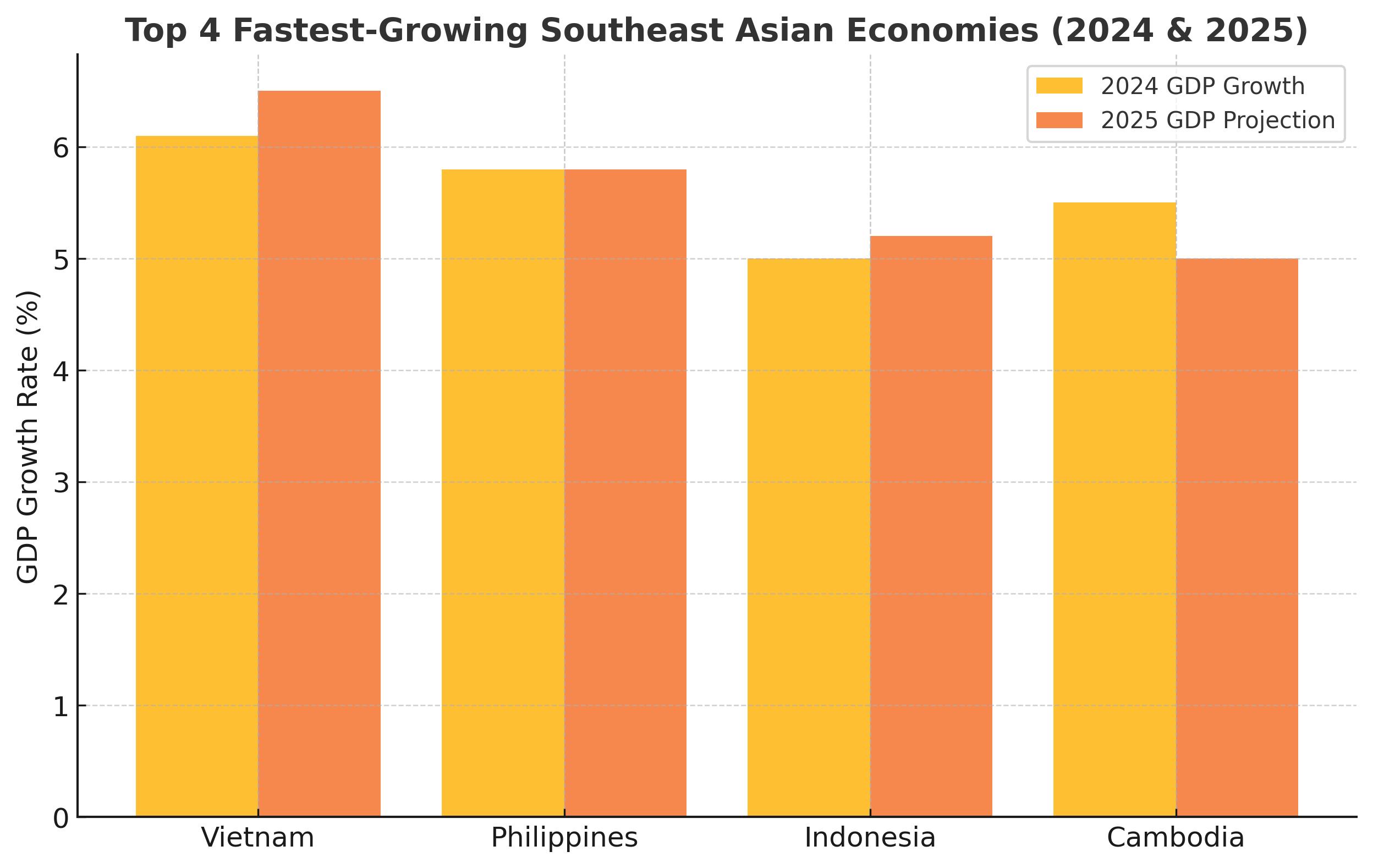
| Vietnam | 6.1% | 6.5% | Manufacturing, exports and inbound investment |
| Philippines | 5.8% | 5.8% | Services, outsourcing and domestic consumption |
| Cambodia | 5.5% | 5.0% | Garments, tourism and inbound capital |
| Indonesia | 5.0% | 5.2% | Scale — the region's largest domestic market |
Two things stand out. The spread between first and fourth is narrower than the ranking suggests — roughly a point separates them, which is noise at the level of a single business decision. And the ordering was expected to change: Indonesia was projected to move ahead of Cambodia in the following year. The composition of the growth is far more decisive than its rank.
02What drives each one
Vietnam led the group on manufacturing and exports, particularly electronics and textiles, sustained by foreign direct investment from companies relocating supply chains and by an increasingly skilled workforce. Public investment in infrastructure and an active role in trade agreements reinforced it. For an arriving company, that profile means industrial capability, engineering talent and a dense supplier base — and a labour market that has been competed over for several years.
The Philippines grew on services rather than factories: outsourcing and financial services, high household consumption supported by remittances from workers abroad, and government infrastructure programmes. The consequence for an employer is a large English-speaking services workforce and a domestic market whose spending is unusually resilient — the reason so many regional back-office and customer operations sit here.
Cambodia grew on garments and textiles, on a tourism sector recovering strongly, and on foreign investment in real estate and agriculture. It is the smallest and least diversified of the four, which cuts both ways: lower costs and fast movement, against thinner infrastructure and a shallower talent pool.
Indonesia is the region's largest economy and grew on its own scale — a vast domestic market, a rapidly expanding digital economy in fintech and e-commerce, and state-led infrastructure. Its growth rate is the lowest of the four and its absolute size is the largest by a distance, which is a different proposition entirely: you go there for the market, not for the rate.

03What the projections expected
The forecasts made at the start of the cycle expected all four to continue upward, with Vietnam accelerating on high-technology manufacturing, renewable energy and digital services; the Philippines holding steady on banking, financial technology, property and tourism; Indonesia gaining momentum on industrial incentives and its digital economy; and Cambodia sustaining growth on tourism, manufacturing and exports while slipping to fourth place.
Two honest caveats. Projections are not outcomes, and this set has since been overtaken by events that no longer make it a forecast at all — verify against published results before quoting any of it. And regional integration, including agreements such as the Regional Comprehensive Economic Partnership, shapes all four in ways that a single national growth rate does not capture. Read the direction of travel here; take the numbers from each country's statistics office.
04What growth means for a mobility budget
This is where the macro figures become concrete, and where companies expanding into the region are most often surprised. Fast growth is not a discount — in the places absorbing the most investment, it does the opposite to the costs a mobility budget actually carries.
- Housing in the districts expatriates want rises faster than the national average, because demand concentrates on a small number of streets.
- International school places tighten before fees rise, and the waiting list is the constraint that delays arrivals most often.
- Senior local talent gets more expensive exactly where the growth is, which is the point of going but rarely in the first budget.
- Office space follows the same curve, with the best-served buildings absorbing demand first.
None of that argues against expanding into a fast-growing market. It argues for budgeting the arrival at the level of the district rather than the country. The costs that break these budgets are documented, with real ranges, in our guide to the hidden costs of relocating within Southeast Asia.
05Choosing a country for the right reason
The useful question is never which economy grows fastest. It is which growth resembles your business. Manufacturing, engineering and a supplier ecosystem point one way; English-speaking services and back-office scale point another; sheer market size points a third. A tenth of a percentage point of GDP growth will not change a location decision. The composition of that growth will.
Three things are worth settling before the spreadsheet closes: where your people would actually live and what that costs, whether the schools your families need have places in the year you intend to move, and how long the immigration route for your profile really takes. All three are district-level and country-specific, and all three are routinely discovered after the decision rather than before it. Our office search service covers the commercial half of that question across the region.
And when the decision is made, the arrival itself — housing, schooling, immigration, the shipment, the settling-in — is a single operation rather than five. That is what our relocation services across Southeast Asia are built to run, with our own offices in Vietnam, Thailand and the Philippines rather than a network of subcontractors.
06Common questions
Which country in Southeast Asia grows fastest?
In the last full cycle we published, Vietnam led on 6.1% growth, ahead of the Philippines at 5.8%, Cambodia at 5.5% and Indonesia at 5.0%. Roughly a point separates first from fourth, which is narrow enough that what drives each economy matters far more than the ranking.
How current are these figures?
They are actual results for 2024 and the projections that were published for 2025 — not current-year data. Treat them as a guide to the structure of each economy, and take up-to-date figures from each country's national statistics office before making an investment decision.
Which is best for a manufacturing operation in Southeast Asia?
Vietnam has the clearest profile: export-led manufacturing in electronics and textiles, a dense supplier base, sustained foreign direct investment and heavy infrastructure spending. The trade-off is a labour market that several years of inbound investment have made competitive, particularly for experienced engineers.
Which is best for a services or back-office operation in Southeast Asia?
The Philippines, on the strength of a large English-speaking workforce, an established outsourcing and financial services sector, and domestic consumption supported by remittances. It is the reason so many regional customer and back-office operations already sit there.
Does fast growth make relocation in Southeast Asia cheaper?
Usually the reverse, at least where it counts. Housing in the districts expatriates choose, international school places and senior local salaries all rise fastest exactly where the investment is concentrating. Budget the arrival at district level rather than at national level.
What should we settle before choosing a country in Southeast Asia?
Three things, all specific rather than macroeconomic: where your people would live and what that costs, whether the schools your families need have places in your intended year, and how long the immigration route for your profile actually takes. Each is decided locally, and each is routinely discovered too late.
Weighing two countries for an expansion?
Tell us the roles you intend to move, the headcount and the timing. We will come back with what an arrival really costs in each candidate city, what the immigration route takes, and where the school constraint sits. Talk to our regional team →