Moving from Bangkok to Canada: How Asia Relocation Coordinates Your Shipment
A practical overview of the Bangkok–Canada shipping route, the BSF186 customs process, and what expats from Thailand typically pack in a container heading to Vancouver or Montreal.
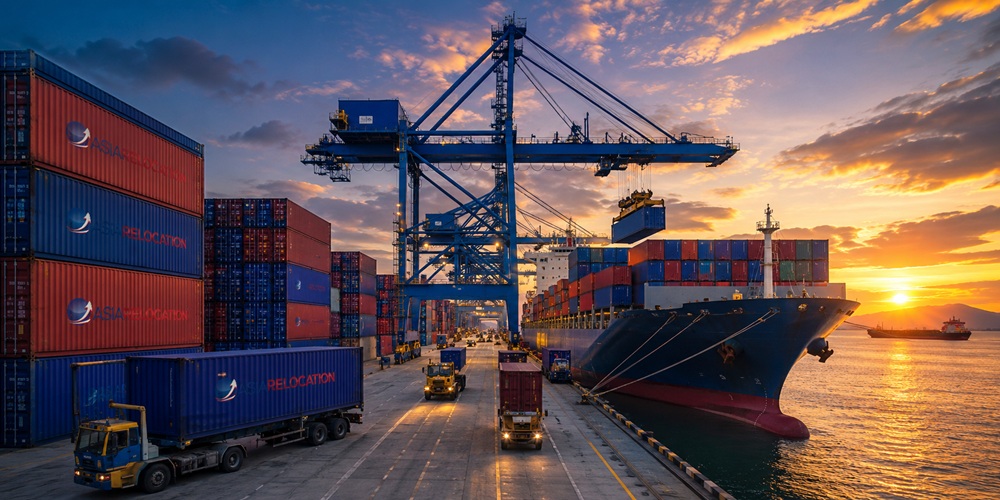
Table of Contents
01Bangkok to Canada: the route
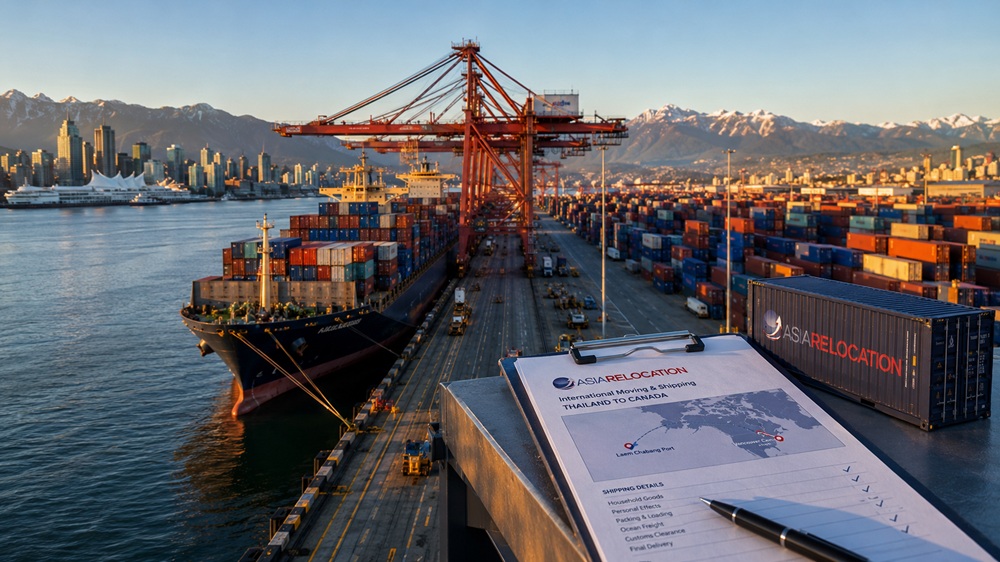
Most household shipments from Bangkok to Canada are routed through Vancouver. The trans-Pacific crossing from Laem Chabang takes 25 to 30 days port-to-port, making Vancouver the most efficient gateway for clients settling in British Columbia, Alberta, or Ontario. For clients relocating to Quebec or the East Coast, Montreal is the practical arrival point — but the routing adds significant transit time: 42 to 48 days, either via the Panama Canal or on transhipment services. That difference matters for planning. Clients I work with sometimes underestimate it when they have a firm start date at a new employer. Air freight from Suvarnabhumi reduces that to 5 to 7 days for urgent items or partial shipments. We manage both modes through our international moving services from Thailand.
| Mode | Departure point | Transit time |
|---|---|---|
| Sea freight — West Coast | Laem Chabang Port — Thailand | 25–30 days |
| Sea freight — East Coast | Laem Chabang Port — Thailand | 42–48 days |
| Air freight | Suvarnabhumi Airport — Bangkok | 5–7 days |
| Main arrival point | Vancouver (West Coast) · Montreal (East Coast) | Main gateways |
Good to know
The transit times above are port-to-port. For a door-to-door estimate from your Bangkok address to your Canadian residence, add 10 to 18 days — origin packing and Thai export clearance, customs clearance at CBSA, and last-mile delivery in Canada. For the Montreal routing specifically, plan accordingly: 42–48 days at sea means a total door-to-door of 55 to 65 days in standard conditions.
02What Asia Relocation coordinates
In practice, a Bangkok–Canada move splits into three operational blocks. The origin block covers everything on the Thai side before the container leaves Laem Chabang. The freight block is the trans-Pacific leg. The destination block covers CBSA clearance and delivery in Canada through our partner network. Where it gets complicated is the handover between blocks — specifically, the customs documentation that needs to travel with the Bill of Lading and arrive at CBSA in the correct format. That is what causes delays when it is not handled as a single coordinated file.
| Service | What we handle | Status |
|---|---|---|
| Origin services Thailand | Pre-move survey, packing, crating, detailed inventory, Thai customs export documentation, drayage to Laem Chabang Port | Included |
| Sea freight Bangkok → Vancouver / Montreal | FCL or LCL booking, Bill of Lading, ISPM-15 compliance for wood packaging, marine insurance coordination, vessel tracking | Included |
| Destination services Canada | CBSA clearance with BSF186 documentation, transport to residence, unloading, unpacking, debris removal | Coordinated |
⚠ Important to know
Marine cargo insurance is not included by default and is strongly recommended for transoceanic shipments. Without declared-value all-risk coverage, carrier liability under international maritime conventions is capped at a figure that rarely reflects the actual value of a household shipment. We provide a separate insurance quote with the moving estimate.
03Customs & import requirements in Canada
Canada Border Services Agency (CBSA) requires a Personal Effects Accounting Document — form BSF186 — for all personal effects and household goods entering Canada. What I tell clients is to think of the BSF186 as a commitment: every item you list on arrival is exempt from duties and taxes, and every item you omit is taxable when it eventually arrives. The form is presented at the first port of entry by the person, not by the goods — which means you declare at your entry point, even if your container lands at Vancouver three weeks later. The exemption framework depends on which status applies to your situation: Settler or Former Resident. Both conditions require goods to have been owned and used for more than six months outside Canada. Full requirements are covered in our Thailand customs regulations guide. For official CBSA requirements and current procedures, refer to the Canada Border Services Agency (CBSA) directly.
- Form BSF186 (Personal Effects Accounting Document) — completed and signed before first entry into Canada. Presented at the port of entry, not at the port where goods arrive. Goods arriving later are listed on a "Goods to Follow" annex.
- Status determination: Settler (Tariff Item 9807.00.00) for first-time permanent residents; Former Resident (Tariff Item 9805.00.00) for Canadian citizens or permanent residents returning after more than 12 months abroad. Conditions differ — the 6-month ownership rule is waived for residences of more than 5 years abroad under certain statuses.
- Detailed inventory with declared value — itemised, in English or French. Generic descriptions ("kitchen items," "clothing") are rejected by CBSA. Each item must have an estimated replacement value.
- ISPM-15 / NIMP-15 compliance — all wood packaging materials (pallets, crates, dunnage) must carry an official mark confirming heat treatment or fumigation. Non-compliant wood packaging is refused or destroyed at the port at the shipper's cost.
- Vehicles and animals: vehicles shipped from Thailand require CFIA inspection and Transport Canada import compliance — this is handled under a separate process. Animals require CFIA health certification and import permits; coordinate with our pet relocation team well in advance.
04What expats from Thailand typically ship
After years coordinating moves from Bangkok, certain categories appear in almost every container heading to Canada. Most items travel without issue, but two categories consistently generate customs or logistics questions: hardwood furniture and 220V electronics. The reality is that Canada runs on 110/120V — not the 220V standard used throughout Thailand and most of Asia. It is worth auditing your appliances before the packing date, not after the container has left Laem Chabang.
| Item category | Notes for Canada | Status |
|---|---|---|
| Teak and hardwood furniture | Admissible as personal effects. All wood packaging must comply with ISPM-15 (heat-treated or fumigated). Declare wood species on the inventory — some teak and tropical hardwood varieties may require CITES documentation if sourced from protected species. | Declare |
| 220V electronics and appliances | Canada operates on 110/120V, 60Hz. Most Thai appliances (air conditioners, washing machines, rice cookers, hair dryers) are not compatible and will not function or may be damaged. Shipping 220V appliances to Canada is rarely practical — evaluate before packing. | Voltage check |
| Thai silk, textiles and personal effects | No import restrictions. Standard inclusion on the BSF186 inventory. Pack textiles in sealed bags or climate-protected cartons — Canadian winters can cause condensation damage to items stored in transit containers. | Standard |
| Food products and natural goods | Most fresh produce, soil, seeds, and plant material are prohibited. Packaged processed foods are generally admissible but must be declared. Thai herbal products and traditional medicines should be declared — CFIA may inspect at arrival. | Declare / Restricted |
05How your move from Bangkok is handled
A Bangkok–Canada move follows four operational stages. Each has its own timing constraints, and the BSF186 documentation that connects stages three and four is the single most common source of delay when it is not prepared before the container departs Thailand. From what I see on the ground, clients who confirm their Canadian entry date and their residence address at least six to eight weeks before the target departure date have the most predictable experience.
01
Pre-move survey
On-site assessment in Bangkok to confirm shipment volume, identify items requiring crating or special packing, and flag any items needing ISPM-15 compliant packaging or export documentation. Quote issued within 48 hours.
02
Packing and origin clearance
Professional packing at your Bangkok residence. Detailed inventory prepared for the BSF186. Thai customs export documentation processed. ISPM-15 compliant crating for wood items. Container loaded and dispatched to Laem Chabang Port.
03
Trans-Pacific sea transit
25–30 days to Vancouver (West Coast) or 42–48 days to Montreal (East Coast). Weekly vessel tracking updates. Marine insurance active throughout. Bill of Lading and customs documentation forwarded to the Canadian customs broker ahead of vessel arrival.
04
CBSA clearance and delivery
Customs clearance at Vancouver or Montreal with BSF186 documentation and Goods to Follow list if applicable. Transport to your Canadian residence. Unloading, unpacking, and debris removal handled by our partner network.
FAQMoving from Bangkok to Canada: common questions
The questions I get most often from clients preparing a Bangkok–Canada move — answered factually, without the usual generalities.
What is the BSF186 form and when do I need to present it?
The BSF186 (Personal Effects Accounting Document) is the form used to declare all household goods and personal effects entering Canada. It is presented to the Canada Border Services Agency at your first port of entry into Canada — which means you declare when you arrive personally, not when your shipment arrives at the port. If your container docks at Vancouver three weeks after your flight lands, you still present the BSF186 on your arrival day. Items arriving after you have already entered Canada are listed on the "Goods to Follow" annex of the same form. Any item not listed on either list will be assessed for duties and taxes on arrival.
What is the difference between Settler status and Former Resident status for Canadian customs?
The two statuses determine which tariff item applies to your personal effects and the conditions for duty exemption. Settler (Tariff Item 9807.00.00) applies to persons establishing permanent residence in Canada for the first time — typically new permanent residents arriving under Express Entry or other immigration programs. Former Resident (Tariff Item 9805.00.00) applies to Canadian citizens or existing permanent residents returning to Canada after living abroad for more than 12 months. Both statuses require goods to have been owned and used for more than six months outside Canada. The six-month ownership rule is modified if the person has lived abroad for more than five years — it is worth confirming your specific situation with our customs broker before finalising the BSF186.
Do I need to be present in Canada when my shipment clears customs?
You do not need to be physically present at the port when your container arrives, but you must have already entered Canada and presented your BSF186 before the goods clear CBSA. Our Canadian partner customs broker handles the clearance process on your behalf using the documentation prepared in Bangkok. What is essential is that the entry date, the BSF186, and the Goods to Follow list are all consistent and filed correctly. Discrepancies between what was declared on arrival and what is found in the container are the most common cause of customs holds.
Can I ship teak furniture and tropical hardwood items from Thailand to Canada?
Yes, teak and other hardwood furniture are admissible as personal effects into Canada. Two requirements apply. First, all wood packaging materials — pallets, crates, dunnage — must be ISPM-15 compliant, meaning they carry an official mark confirming heat treatment or fumigation. We use ISPM-15 certified packaging as a standard for all Thailand exports. Second, the wood species must be declared on the inventory. Certain tropical hardwoods may require CITES documentation if they are classified as protected species — we flag these items during the pre-move survey so there are no surprises at the CBSA inspection stage.
My household goods include items bought in Thailand that are not yet six months old. What happens?
Items that do not meet the six-month ownership and use condition are not eligible for the BSF186 duty exemption and will be assessed at the applicable duty and tax rate by CBSA. In practice, this matters most for new electronics, appliances purchased recently, or high-value items acquired late in an assignment. The correct approach is to list these items separately on the inventory with accurate purchase dates and values, so the customs broker can handle them cleanly at clearance rather than having them identified during an inspection. Attempting to include non-qualifying items under the exemption creates a more serious problem than simply paying the applicable rate.
06Additional services & next steps
Most Bangkok–Canada moves involve more than a single container of household goods. If you have a pet, a vehicle, or need temporary storage in Bangkok before your departure date is confirmed, we coordinate those services separately but in sync with your main shipment timeline. When you are ready to discuss your specific situation, you can request a moving quote and we will arrange a survey.
🐾
Pet Relocation
Moving with a pet to Canada? We coordinate CFIA export health certificates, Canadian import permits, rabies vaccination requirements, and airline-approved transport from Bangkok. Requirements vary by species — start early.
🚗
Vehicle Transport
Shipping a car or motorcycle from Thailand? We manage RO-RO loading at Laem Chabang, export documentation, and destination customs clearance with Transport Canada compliance checks.
📦
Storage in Bangkok
If your arrival date in Canada is uncertain — immigration processing, housing delays — our Bangkok air-conditioned storage facilities keep your goods secure and fully insured until your container is ready to ship.
🛡
Moving Insurance
All-risk marine cargo insurance covering your full shipment from Bangkok to Canada. Declared value, door-to-door coverage — the trans-Pacific crossing is long and declared-value coverage is the correct approach for household goods.
25–30
Key figure
Days port-to-port — Laem Chabang Bangkok to Vancouver Canada, standard sea freight (West Coast routing).


GET A QUOTE